Narrow Dental Implants in Posterior Sites: What the Science Really Says
By Super Implants | Clinical Intelligence Series
For years, clinicians hesitated to use narrow dental implants (NDIs) beyond the anterior zone. The assumption was simple: posterior sites demand wider, stronger implants to handle heavier bite forces. But what does the evidence actually tell us?
Thanks to a comprehensive AI-powered review of over 170 million research papers — presented at the Dentium EUROFORUM Malta 2026 — the literature now provides one of the clearest answers to date.
The Headline Finding: Narrow Implants Work
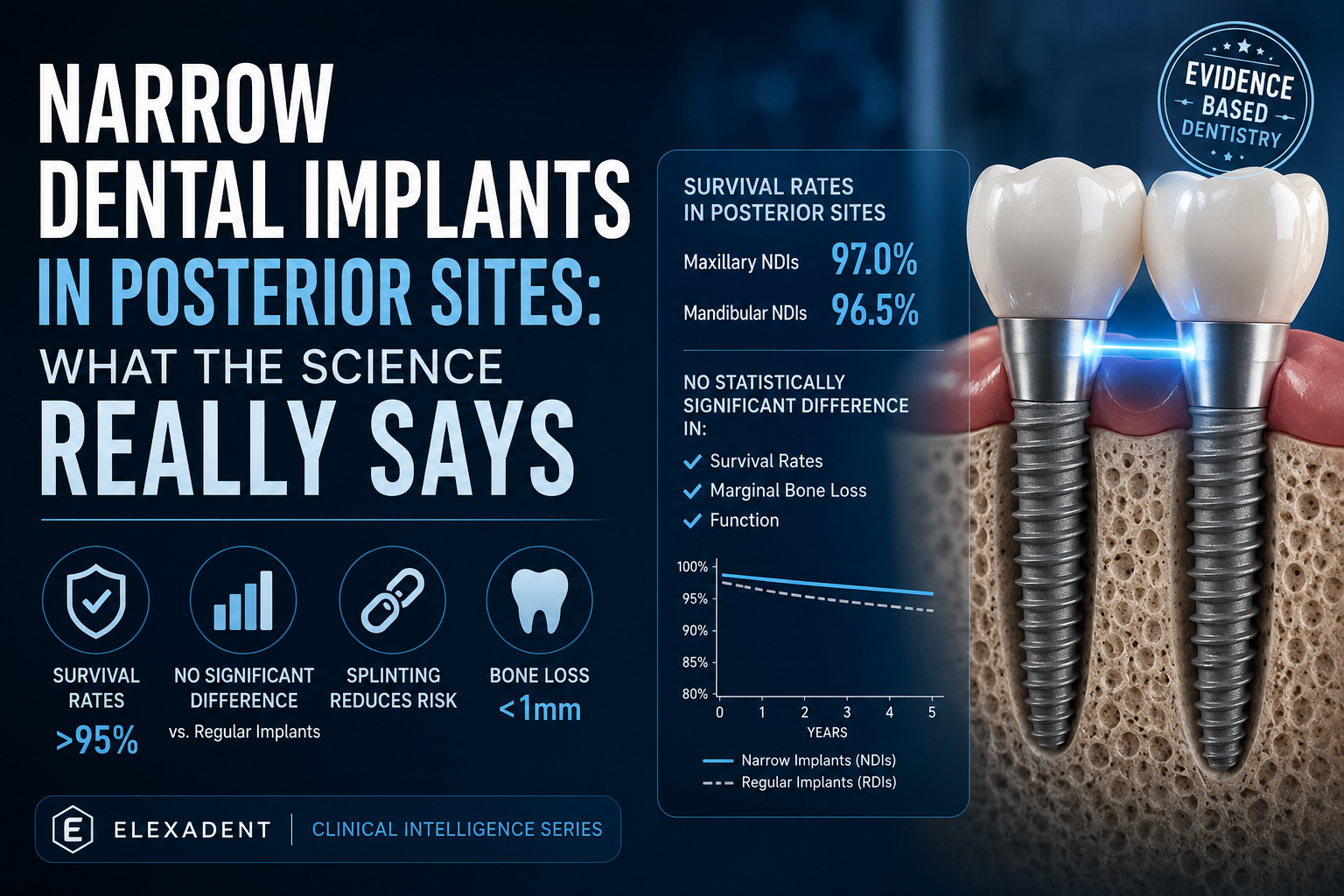
Survival rates for NDIs in posterior jaws consistently exceed 95%, with maxillary NDIs pooling at 97.0% and mandibular NDIs at 96.5%.
Crucially, multiple randomised controlled trials show no statistically significant difference between NDIs and regular-diameter implants (RDIs) in terms of:
- Implant survival rates
- Marginal bone loss
- Long-term function in molar and premolar regions
This includes cases involving single-crown restorations in posterior sites traditionally considered higher risk.
What About the Risks?
Mechanical complications such as screw loosening can occur, but reported rates remain generally low.
The literature identifies one particularly important clinical safeguard: splinting.
When multiple NDIs are splinted together:
- Fracture risk decreases significantly
- Fatigue resistance improves
- Occlusal load distribution becomes more predictable
Marginal bone loss in the reviewed studies typically remained below 1mm over several years, while biological complication rates were comparable to those observed with standard-diameter implants.
Important Clinical Boundary
Very narrow “mini” implants below 2.5mm diameter are not recommended for load-bearing posterior applications.
Current evidence supporting these ultra-narrow systems remains limited, and clinicians should remain within validated diameter ranges supported by long-term clinical data.
Why This Matters Clinically
The real-world value of NDIs extends beyond the implant itself.
In cases with limited horizontal bone width, selecting a narrow implant can often help clinicians:
- Avoid bone augmentation procedures
- Reduce patient morbidity
- Shorten treatment timelines
- Lower overall treatment cost
Patient-reported satisfaction in NDI studies also remains consistently high for both:
- Functional performance
- Aesthetic outcomes
The Bottom Line
NDIs are no longer a compromise solution.
When selected appropriately, placed precisely, and restored using sound prosthetic principles — particularly splinting under heavier occlusal loads — narrow implants demonstrate outcomes that stand alongside standard implants throughout the literature.
At Super Implants, we believe clinicians deserve access to both the evidence and the systems required to act on it. Science is the foundation — everything else builds from there.
References
Source material presented at the Dentium EUROFORUM Malta 2026.
Key references include:
- Pachiou et al. (2025)
- De Souza et al. (2017)
- Zhu et al. (2025)
- Terrats et al. (2024)
Alongside 46 additional peer-reviewed publications included within the Consensus AI Review.